
Genetic Relationships Explained
Understanding how your family members are related isn’t just interesting — it’s the foundation of protecting them. Knowing who shares blood ties with whom helps with everything from medical history and age-progression to building an accurate family tree. This guide explains genetic (blood) relationships in plain language, using the average share of DNA two relatives have in common.
Every step away from you cuts the shared DNA roughly in half. You share 50% with a parent, 25% with a grandparent, 12.5% with a great-grandparent, and so on. The smaller the percentage, the more distant the genetic tie. The chart starts with you and expands out. We also give more information after the chart.

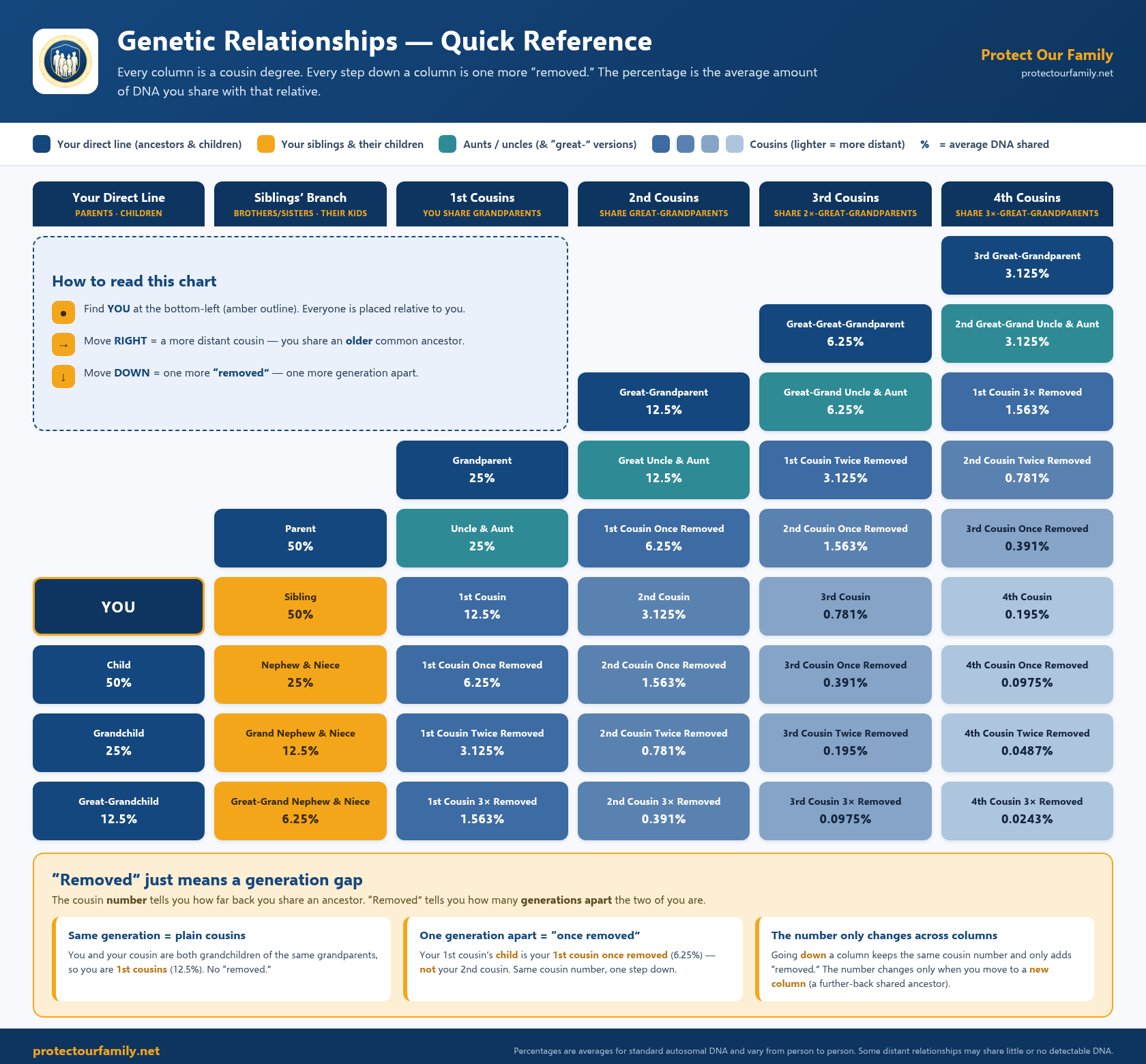
What Does “Removed” Mean?
“Removed” is one of the most misunderstood words in family trees — but it’s simple.
• Same generation? You are plain cousins — first, second, third, and so on. This is driven by the ‘great’ level of ancestors.
• Different generations? That’s where “removed” comes in.
– Once removed = one generation apart.
– Twice removed = two generations apart.
Example: Your first cousin’s child is your first cousin, once removed — not your second cousin. You’d have to go to your cousin’s grandchild to be twice removed.
• These percentages are averages. Because of how DNA is passed down at random, the exact amount two relatives share varies from person to person. Parent-to-child is the one constant — always almost exactly 50%.
• Genetic vs. non-genetic. Adoptive, step, foster, and guardian relationships are every bit as real and important as blood ties — they simply don’t share DNA. Protect Our Family tracks both, because the people who love and protect a child matter just as much as biology.
• Why this matters for safety. Accurate genetic relationships power age-progression imagery, medical-history context, and a correct family tree — all of which help protect the people you love.